
BBQ sauce looks simple on the surface, yet producing it at scale requires careful control so every bottle tastes the same, pours the same, and stays safe on a shelf. That consistency is not accidental; it comes from processing steps that turn raw ingredients into a stable, repeatable product.
Once you understand how BBQ sauce is processed, you begin to see why certain brands taste cleaner, why some sauces feel smoother, and why the category of BBQ sauce stays dependable as a pantry staple rather than behaving like a fragile homemade mixture.
1. Ingredient Preparation: The Quiet Start That Sets Quality
Production begins with preparing ingredients so they behave predictably during cooking and blending. Tomatoes may arrive as paste, purée, or concentrated base, while dry spices are often sifted or pre-mixed to avoid clumps and uneven flavour pockets.
Sweeteners and acids are also standardised. This step matters because ingredients behave differently depending on concentration, temperature, and even storage conditions. When a brand controls this first stage well, the finished sauce tends to taste coherent rather than chaotic.
2. Blending and Emulsifying: Building the Sauce’s Structure
After preparation, ingredients are combined in mixing tanks and blended until the sauce becomes uniform. This is where texture begins to take shape, because a sauce must hold together as one consistent mixture rather than separating into layers.
Some producers use high-shear mixing to distribute oils, spice particles, and thick components evenly. Others rely on slower blending and longer cook times. The method matters because it affects how the sauce feels on the tongue and how it behaves in the bottle, issues that often show up later in the way a sauce holds its consistency over time.
3. Cooking and Reduction: Where Flavour Becomes “Rounded”
Most commercial BBQ sauces are heated during production. Heat does several jobs at once: it dissolves sugars, develops aroma, thickens the sauce through reduction, and helps spices release their oils.
At this stage, timing is everything. Too little heat can leave the sauce tasting thin and under-developed, while too much can produce a heavy “cooked” note that buries brightness and makes sweetness feel blunt.
In well-managed production, cooking becomes a controlled flavour-building step rather than a simple boil.
4. Acid Control and Final Adjustments: Balancing Before Bottling
Acid is often adjusted near the end, because vinegar and other acids can change flavour intensity quickly. Small changes can shift a sauce from balanced to harsh, so brands typically measure and refine the final profile carefully.
This is also the moment when stabilisers or thickeners may be added if the formulation requires them. A sauce made from strong base ingredients usually needs fewer fixes, which is one reason label reading becomes such a useful skill for shoppers who want clarity, especially when you notice the phrases that signal whether a sauce depends on simple ingredients or heavy correction.
5. Heat Treatment: Making the Sauce Safe and Shelf-Ready
Before bottling (or sometimes after filling), many sauces are heat-treated to reduce microorganisms and ensure the product remains safe at room temperature. This is one of the key differences between commercial sauces and homemade sauces, because commercial processing is designed for stability and predictable shelf life.
This step also influences texture. A properly treated sauce tends to remain smooth and stable, while poor control can lead to separation, graininess, or flavour dulling over time.
6. Filling, Sealing, and Cooling: Protecting Flavour and Consistency
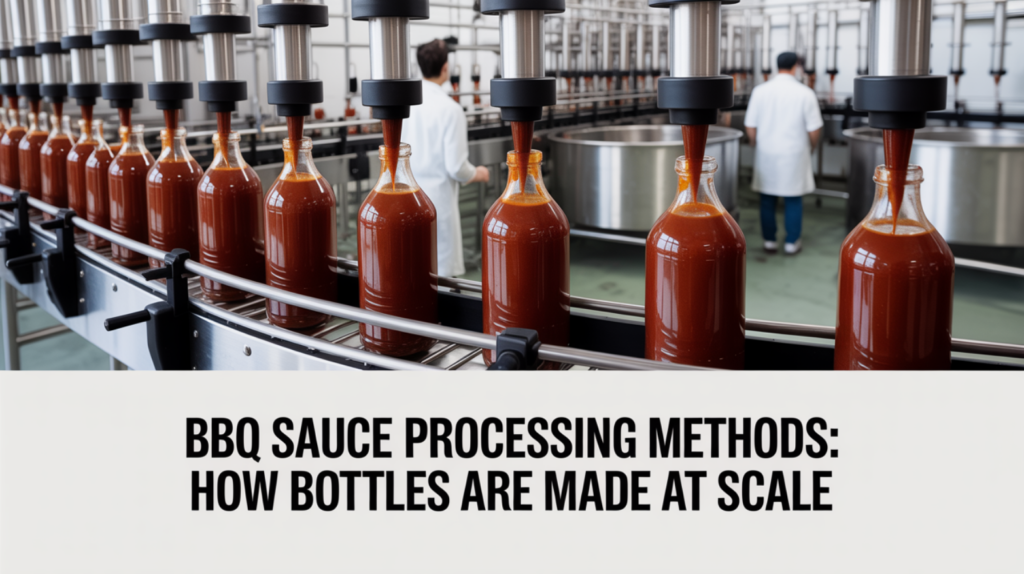
Once the sauce reaches its finished state, it is filled into bottles or jars under controlled conditions. Bottles are sealed quickly to reduce oxygen exposure, since oxygen can slowly flatten aroma and darken colour.
After sealing, cooling is managed so the sauce sets to its final thickness without creating condensation issues that could interfere with stability. This is a practical detail, yet it strongly affects the everyday experience of using the sauce.
Conclusion – Processing Is the Hidden Reason Some Brands Feel “Reliable”
Commercial BBQ sauce processing is essentially a system of control: control of ingredients, control of mixing, control of heat, control of acidity, and control of packaging. When those steps are handled well, the sauce tastes consistent, pours smoothly, and remains stable for long periods without losing its character.
Once you understand the process behind the bottle, you stop seeing BBQ sauce as a simple condiment and start recognising it as a carefully engineered pantry product, designed to be repeatable, safe, and satisfying every time you open it.